


The OCR World Championships: Botteling it on the world stage

Updated: Aug 23

In 2016, I found myself standing on the start line of the OCR World Championships in the Blue Mountains, Canada, the highest level of obstacle racing in the world. I had trained, qualified, travelled, and now I was here… in my UK kit, elite wave, heart pounding under the inflatable arch that proudly read “WORLD CHAMPS 2016”.
I crossed the finish line in tears. Not the victorious kind. The broken kind. I was angry. Embarrassed. I didn’t want to talk about what had happened that day. I was “that girl.” The one who froze. The one who failed.
For years this blog has been sat in my drafts. I didn’t want people to see me as weak, but with age comes a sense of not caring what others think any more. In posting my Derby blogs I have decided now is the time to post this blog and tell the world exactly what happened. What happened to the girl who sat on an obstacle for hours at the World Championships? Why did she not just jump?
First lets rewind a little. Because getting there in the first place was something of an unexpected journey…
Qualifying:
In the year leading up to the World Championships, OCR was my world. I was competing almost every weekend, darting between trail runs and obstacle courses, chasing mud, medals, and personal bests. By winter 2015, I was craving something new, less cold, less mud, and maybe a touch of sunshine.
So, I booked a trip to Dubai with a friend to take on the Spartan Super and Sprint races. The desert heat was brutal, but the course? Surprisingly kind. Dry obstacles, no mud, no ice baths or slippery monkey bars. It was all very manageable compared to UK races.
I ran strong and clean, finishing 4th in the women’s overall gender category. That placing, somewhat unexpectedly, secured me a spot to represent the UK in the Women’s Elite wave at the OCR World Championships in Canada. A bit of a fluke? Maybe. But it felt like a once-in-a-lifetime adventure, so I grabbed it with both hands. Lets be honest its not often a very ordinary person gets to represent their country at something, so I thought, why not? What was the worst that could happen?

Training: Paul, Plyometrics and Perseverance
Once the invite came, things got serious. I was already racing most weekends, but I honed into my training further with my coach, Paul Slythe, at Bob Prowse Health Club. He changed my routine entirely, introducing me to plyometric circuits, mobility work, calisthenics, heavy strength training, and structured cardio. We were not just going trial running now, we were competing and my training needed to change accordingly.
I wouldn’t have made it without Paul. He instilled the discipline and belief that I could do hard things and would bring my “it will be fine” attitude back to reality, he would often explain that it would not just be okay if I did not train correctly. This was not some small local OCR race now, where I could blag my way through; this was me going up against some of the fittest people in the world.
My friend Karen (who was also going to Canada) and I trained together, hitting up outdoor OCR facilities, getting our hands literally dirty to prepare for anything Canada might throw at us.
But in hindsight, nothing could have quite prepared me for what I was about to face.
Arriving in Canada: The adult school trip.
The run-up to the trip was electric. Sponsorships, packing shiny new UK team kit, and seeing messages of encouragement pour in, I genuinely felt like a real athlete.
Roughly 30 of us from Team UK flew out together. It was like a school trip for grown-up OCR fanatics. We explored, laughed, and bonded over the anticipation. Once we’d dumped our bags at the lodge, we made a beeline for the event village to scope things out.

It was there that the nerves kicked in. The obstacles were massive, a lot bigger than I was used to. Think Ninja Warrior scale, towering rigs, complex grip-based structures, and one in particular that sent a chill through me: The Dragon’s Back. I had never seen anything like it, and I was rubbish with jumping off things. The dragon's back consisted of a series of high platforms with wide gaps that required a leap of faith off the ledge to a bar, pull yourself up onto the next ledge and repeat the process along the raised platforms.

I turned to Karen, whispering, “I think I might be disqualified quite soon on…”. She shook her head and smiled, insisting I would be fine. I knew that jumping off things into water was a huge block for me in previous races. To be expected to jump off something without the comfort of water below was going to be a real challenge. However, I put it to the back of my mind and assured myself that it was a “tomorrow problem”.

Event Day: The Best and Worst of Me
The house woke up early to a buzz in the air. 15km and 40 obstacles lay ahead. Karen and I braided our hair, put on our Team UK kits, and tried to calm our nerves.
I was the second wave out on course. I felt strong. I knew I could run. I liked hills. I loved obstacles. I was ready.
The mountain air was sharp, fresh, and buzzing with adrenaline. You could feel it in your chest, like electricity in the atmosphere. The site itself was breathtaking: trees flaming with autumn colour, mist curling around the peaks. Massive screens played footage from previous championships and the competitors stood stoic, this was a little different to the fun, chattery, laughing start lines of the previous years.
I lined up under the giant arch marked "OCR WORLD CHAMPS 2016". Every single woman looked carved from granite, displaying abs like cobblestones and arms you wouldn’t want to arm-wrestle. A deep American voice boomed from the speakers:
“WOMEN. YOU ARE ELITE. YOU ARE THE BEST IN THE WORLD.”
It sent shivers down my spine. Me? Elite? It felt surreal. The countdown began. My heart was thudding. I felt fire in my belly. My heart pounded with pride. Imposter syndrome settled in my gut.3… 2… 1…Go.
The runners launched onto the course.

The first few kilometres were a dream, weaving through trail paths, ducking into the woods, leaping over walls and hurdles. They were a little bit bigger than what I was used to, but each one was overcome with relative ease. The Canadian mountain trails were steep, technical, and relentless, but this was my happy place, and I was incredibly proud of myself for representing the UK. I overtook a few racers and found a rhythm, a far cry from the useless at sports teenager I had once been.
I was in it. Focused. Flowing. Alive. Then, everything changed.
The Dragon's Back.
As I approached the event village portion of the course, the crowd thickened. Music pounded from speakers. Announcers barked updates. A huge screen replayed footage of racers at key obstacles. You could hear gasps and cheers echo across the valley.
If you know OCR, you know the obstacle called "The Dragons Back". If you don’t... imagine a towering metal platform. You leap from one ledge to another with a drop beneath. Miss the jump and… you hit your face on the bar you were meant to grab and slide to the floor.
I climbed the ladder to the first platform and stood frozen, toes just on the edge. Ahead of me: a void. Then a bar. Then another platform. Then the same again.
I knew what to do. I just couldn’t do it.
My body refused. My brain screamed jump, but my legs turned to concrete. It felt like I was about to jump off a roof. There were no mats. No safety nets. No water. Just air, steel, and pressure.
It didn’t just scare me, it paralysed me.
People were behind me, pushing past. Time was ticking. The sun beat down. I could hear whispers and see marshals watching. Spectators shouted support and words of encouragement, which quickly turned to shock when they realised I was not going to jump any time soon.. I was the “elite” who wouldn’t jump.
Racers passed me. They leapt boldly, some catching the bar like gymnasts. Others missed, landing hard. I saw one man crash jaw-first into the bar. I couldn’t breathe. My heart slammed in my chest like it was trying to escape. I stepped up to the ledges edge. Then back. Then up again. I couldn’t make the leap. Each time my body jolted to a standstill. The gap wasn’t that big, but it felt bottomless.

For over an hour, I stood there. My ego, my pride, my identity, all cracking in the heat. I wasn’t just afraid of the fall. I was afraid of failing in front of everyone.
Minutes turned into hours. The sun scorched my neck. The crowd below grew. Cameras clicked. People pointed and videoed on social media. The commentator noticed I wasn’t moving and started saying things like, “She’s been up there a while now, come on, UK!”
The lovely obstacle marshal tried to beckon me down and out of the way.
"Why don't you just come down, give me a band and you can be on your way" the Marshall said.
"I can't give up my band", I replied.
For some reason, I had this unholy attachment to a piece of rubber that would be cut from my wrist for failing an obstacle. It was my pride and joy to show I had completed the UK Worlds properly, this could not be bought you had to earn it and I was not giving it up easily.
Two hours on the obstacle, I watched my race slip away in real-time as racers were crossing the finish line just ahead in the event village. Quite a crowd had formed below me now.
“You’ve got this!”
“Just go! Don’t overthink!”
“COME ON, GIRL!” "Jump! Jump!" the crowd cheered.
Every bone in my being willed me to leap, I wanted to, I really did. Apart from feeling stupid and being embarrassed, there was a part of me now that was too stubborn to just get down after so much time spent up here. Eventually, the obstacle marshal asked if I wanted a drink and food. I nodded, holding back tears of embarrassment and shame. I devoured the food, gulped down the water and walked to the edge of the ledge. The crowd cheered, I went to jump and then, my legs would not move once again. I stood frozen for another 30 minutes.
More time passed, more racers flew past me and eventually one of the race organisers came to see me.
“You really need to jump or get down" he said "We can’t have you just standing up there. You are not going to finish in the time frame now anyway, so you'll be disqualified, you may as well get down and give us your band"
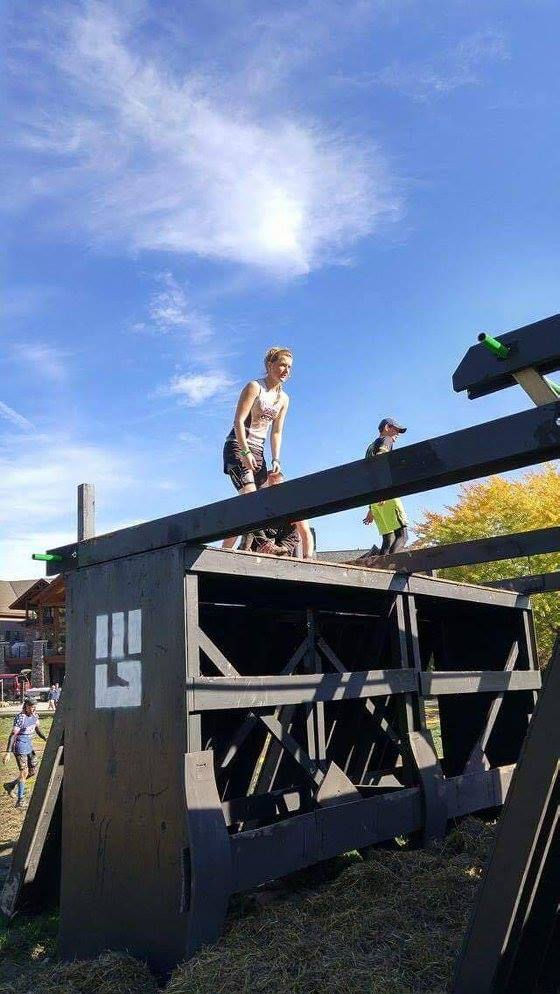
I was nearly crying at this point, I was overheating, I was embarrassed by the scene I had caused, and I didn't want people to be watching, filming and posting about what a wuss I was. I hung my head and contemplated going down the ladder I had climbed over two and a half hours ago.
"EMMELIA!" I heard from behind me, coming up to the top of the ledge.
It was Katy, one of the UK women competing in her age group. Someone I knew well from competing in the UK, an OCR friend.
"I am not leaving until you jump with me!" Katy exclaimed.
"I can't, I don't know why, I just can't!" I replied.
She smiled, she gave me a hug, she told me it was okay, she jump the first ledge and then stood on the other side and waited for me. I stood on the edge listening to her encouragement, trying to block out the chanting from the crowd below.
"It’s just like being at home, be brave and jump, then we can get some water" She smiled, sat on the edge of the next ledge. "I am not moving until you jump"
She offered no judgment. Just presence. A reminder that I wasn’t alone.
The thought of letting someone else down and ruining their race time is ultimately what got me to jump. I paused for a few minutes and eventually looked at Katy, outstretched my arms and flung myself off the ledge. My hands grasped frantically for the bar to avoid smashing my face.
I caught the bar.
Raucous applause sounded around the obstacle.
"WHEYYYYYYY!!!!” the crowd cheered.
I felt ridiculous; I was so embarrassed. Nearly 3 hours on top of the dragon's back, and I had totally disgraced myself and my country.

“Thank you", I whispered to Katy, "thank you so much"
"Next one!" she beamed at me, and we jumped it together.
Eventually, we found our way to the other side and down to complete the dragon's back. The obstacle marshal came to hug me.
"Well done, you did amazingly"
The crowd continued to cheer as Katy and I jogged down the path to the next obstacle.
I felt like an A-class idiot.
What on Earth had I been thinking? That really was not that bad.
The rest of the race:
The next obstacle was a long, technical rig. My first attempt was okay, I got halfway and then I slipped. However, the retry lane was long, very long and I was tired and dehydrated from sunbathing for 3 hours at the last obstacle.
I queued once more at the rig, failed again and looked at the line of racers waiting for another go in a bid to save their bands. I deemed it not worthy of trying a third time. I would never finish this course if I queued for another 15 minutes. I was exhausted and grouchy and just wanted to finish.
I begrudgingly walked to the marshal and had my band cut off. I was numb. But weirdly, not devastated.

I expected it to hurt more, to be sad, but instead I chastised myself for wasting so much time on the last obstacle just because of a bloody band. I was never going to complete all the obstacles and keep the band; it was naive to think I would.
Kicking myself, I trotted off away from the rig up the mountain to search for the next obstacle. It was here that I began to feel awful. Running up mountains in the blistering heat, having not eaten for hours and having likely sunstroke, does not make for running perfection. I forced my legs on up the inclines, tackling obstacles as and when they appeared. Fortunately, there was nothing too awful in the hills, and I could just about do them all with my waning energy.
As I came to the top of the second mountain climb, I bent over and heaved, depositing any of my stomach contents into the neighbouring scrubland. I wretched over and over again until there was nothing left.
"Stand up and keep moving", I thought. “You are over halfway you need to keep moving to the forest section where there is shade”.
I was running on fumes. But I kept going. Why? I couldn’t tell you then. But looking back, I know: I needed to finish. Not for a medal. Not for social media. But for myself. I would never have forgiven myself for finishing on the shame of the Dragons back and being sick. I had to try and recoup some self dignity.
I ploughed on, shading my face and head with my hands in a bid to undo the sun damage already etched onto my skin and scalp. Once I reached flattish terrain at the top of the mountain, I approached another rig, the skull rig. It was hard but nothing compared to the one previously.

Without the burden of keeping my band and pressure to perform, I eventually completed the rig and jogged along the Stairway to heaven obstacle
"Yes!" I thought to myself, “You aren’t useless!”
The stairway to heaven obstacle I couldn’t do on my best days in the UK. I gave it a couple of goes and eventually decided to call it quits as the downhill and forest shade beckoned me towards the finish line.
Once in the forest, I began to feel slightly better. The temperature cooled down, my head cleared a bit and I had been to a water station after the last obstacle to prevent totally drying out. Letting my legs free-wheel down the BMX tracks in the forest, I was content that I had continued.
"I might be disqualified, but at least I have had the full experience and not given up", I considered as I inhaled deep breaths of cool mountain air.
Once out of the forest, there was a winding track of obstacles up to the village finish line. Again, nothing too tricky, floating rock climbing walls, more traverse poles, a few walls, moving monkey bar hoops, the standard sort of thing I was used to.

I came towards the penultimate obstacle, ninja warrior wheels. I had always struggled with these. I shook my head and realised I was far too confident that I would keep my band and had put too much pressure on myself to keep it.
“I never would have made it past these or the Stairway to Heaven in peak condition", I thought.
I gave the wheels a go, got halfway and my body fell to the floor limply. I had nothing left in the tank at all. I stood up and gazed to the second half of the obstacle, rotating side rings, usually an easy feat for me. I leapt up, missed the wheels and grabbed hold of the first red ring in a bid to redeem some confidence and sense of self in front of the crowds watching. I clung with all my might onto each ring as I steadily made my way along each hand grip, rhythmically swinging my legs in time to my arms' reach. I completed the obstacle with people cheering

The last obstacle was a generic slanted wall at a slope that you had to run up and grab hold of the top or pyramid each other over. It was tall and there were already a lot of runners pyramiding each other up.
I was not exactly pressed for time, so I joined the bottom of the pyramid, helping others up and over. It was here that I recalled why I started OCR. The teamwork, the sense of spirit!
I had nothing left. Physically empty. Bandless. Broken. And yet, I helped others over. Pushed one, lifted another. Because that’s what OCR is about. Not perfection. Not pride. But persistence and helping people. I felt content. I had got so caught up in the competition and worrying about what people thought that I forgot why I loved this sport.
I spent ages helping people over, laughing when they said I was the dragon back girl and thank you for the boost. Eventually, the man next to me told me to stand on his shoulder to grab onto the next person so I could get to the finish.
"Sounds like you've been out on course long enough", he smiled at me after we had been chatting at the human pyramid. So I climbed up him and the next person and the next until I eventually reached the top of the structure and could see the finish line just below in the event village. As I slid down the other side of the wall all the emotions began to bubble over.
I stumbled towards the finish line and a commentator shouted:
“POTTS is now crossing the line!”
I crossed the finish line in tears. Not the victorious kind. The broken kind. I was angry. Embarrassed. I didn’t want to talk about it. I was “that girl.” The one who froze. The one who failed.
That night, after food and showers and the after party, I found out a lot of the elite racers didn’t finish with bands. I wasn’t alone.

What That Race Really Gave Me
That day stripped away everything I thought made me strong: the training, the status, the ego. And it showed me what real strength looks like.
It looks like getting back up when you’re dizzy and alone. It looks like jumping even when your whole body screams “no.” It looks like finishing a race, bandless, broken, and still finding a reason to be proud. I failed three of the obstacles. Which in hindsight, was incredible. I was far too hard on myself at the time.
I no longer see 2016 as a failure. I see it as a reminder. To grow. To struggle. And to always, always, show up and try your best. Not to mention, as most of my blog stories are, an ego check.
It was this failure and pushing through (as well as others!) that ultimately means I now know I am mentally strong enough to take on adventures like the Mongol Derby and face adversity and problems. At the time I felt like a muppet and a faliure, but now I draw on this expirience in tough times (such as loosing a horse in the middle of Mongolia) to know I can carry on when things do not go to plan.
Would I Do It Again?
Yes. In a heartbeat.
But I’d do it with more compassion for myself and more respect for the obstacles. More understanding of what “elite” really means was also required as I went in with far too much confidence and with too many self-inflicted rules and pressures.

Final Thoughts
The 2016 OCR World Championships didn’t go to plan, but it's an experience I will treasure forever and it is the soul memory when I am stuck at an event and struggling, that I can do anything. I can push through tough times, I can do things I didn’t think possible. It has served me well in testing times for adventures and activities since.

CONCLUSION
There’s a very specific kind of pain that comes not from failing, but from freezing. It’s quieter. Slower. It doesn’t bruise the skin but bruises the soul. I stood on that platform, not for five minutes, not even for thirty, but for hours. Stripped of all bravado, laid bare under the sun, becoming the spectacle no athlete ever wants to be, “the elite woman who wouldn’t jump.”
I wasn’t just afraid of the obstacle. I was afraid of failing in public. Of being mocked. Of not living up to the version of myself I thought I had to be. And that fear, it swallowed me whole.
In 2016, I went to Canada to represent the UK in the OCR World Championships. I didn’t come home with a podium finish or even a band around my wrist; technically, it was a DNF, but what I brought back was far more valuable. I left with humility, resilience, and a rediscovered love for the sport that had given me so much. I learned that courage isn’t always about being fearless; sometimes, it’s about standing on a ledge for hours, crying, embarrassed, sunburnt and dehydrated, and still refusing to give up.
It’s been nearly a decade since that unforgettable race, and while I once saw it as a public failure, I now see it as a personal victory. Because I didn’t quit, and that counts. I faced something I couldn’t train for: fear.
For years, I didn’t talk about this race. I buried the story. But now, in 2025, I’ve pulled out my drafts and decided to tell it, because I’m no longer ashamed. I showed up. I tried. And I didn’t quit.
And honestly? If I could do half the things now that I did in 2016, I’d be over the moon. So I am proud of younger me for even having the guts to give this a go.

For Anyone Taking on Their First OCR: Here’s What I Wish I Knew
1. Train hard, but train smart. Simulate real terrain. Grip. Carry. Climb. And suffer in training, so race day doesn’t shock you.
2. Hydrate early and often. Heat exhaustion doesn’t warn you that it is coming.
3. Failure is not the opposite of success. It's a part of it. Own it.
4. You’re not racing alone. Accept help. Offer help. OCR is a team sport in disguise.
5. Your band doesn’t define you. Your effort does. Your honesty does. Your willingness to keep going when everything says stop, that’s what matters.
6. Mix it up: OCRs require a hybrid of endurance, strength, agility, and mental toughness. Include running (especially hills!), callisthenics, plyometrics, grip strength, and mobility work.
7. Practice obstacles: Visit OCR-specific training facilities or ninja gyms. Simulate conditions, wet grip, fatigue, etc. Don’t just train for what you know.
8. Strengthen your mind: Fear can undo your training. Visualisation, breathwork, and positive self-talk can be as important as physical prep. If there is an obstacle you think you might bottle it at, go and find one and practice.

9. Eat well, early: Avoid GI issues by eating something familiar and easily digestible 1.5–2 hours before the race.
10. Carry emergency nutrition: Gels, chews, or salt tabs may just get you through that “dark patch” halfway up a mountain.
11. Invest in trail shoes: You need grip for both mud and mountain.
12. Test your kit: Race day is not the time to wear brand-new clothes or shoes.
13. Pack spares: Dry clothes, a towel, snacks, and even a bin bag for your post-race kit will make your day better.
14. Not finishing is not failure: OCR World Champs are meant to be hard. Bands get cut. It's part of the game.
15. Leave your ego behind: You’re there to challenge yourself, not to impress anyone.
16. Enjoy the ride: OCRs are a celebration of human capability at all levels. Laugh, fail, jump, fall, climb, and connect.
17. Help others, accept help: You’re not weaker for needing support, you’re stronger for recognising it.
18. Remember why you started: Whether it was fitness, fun, or a challenge, hold on to your ‘why.’
19. Arrive Early: Walk the course if possible. Know the terrain, obstacle placements, and where the tough parts will be.
20. Respect the Course: Mountains are not your friend — train for inclines and descents.
21. Don’t Obsess Over the Band: Yes, it’s a badge of pride. But if it goes, your race isn’t over. Experience matters more than hardware.
22. Run trails, not treadmills. Your ankles will thank you for the stability training.

Performing under intense pressure requires mastering your mental game just as much as your physical conditioning. If you want a coach who understands how to build competitive resilience and guide you through the psychological hurdles of high-stakes racing, click here to learn more about my 1-on-1 Bespoke Endurance Coaching.


Comments